Union Territories are a unique form of administrative division in India that are governed directly by the Central Government, unlike states which have their own elected governments. Understanding Union Territories is essential for anyone studying Indian politics, geography, or governance.
What Is a Union Territory?
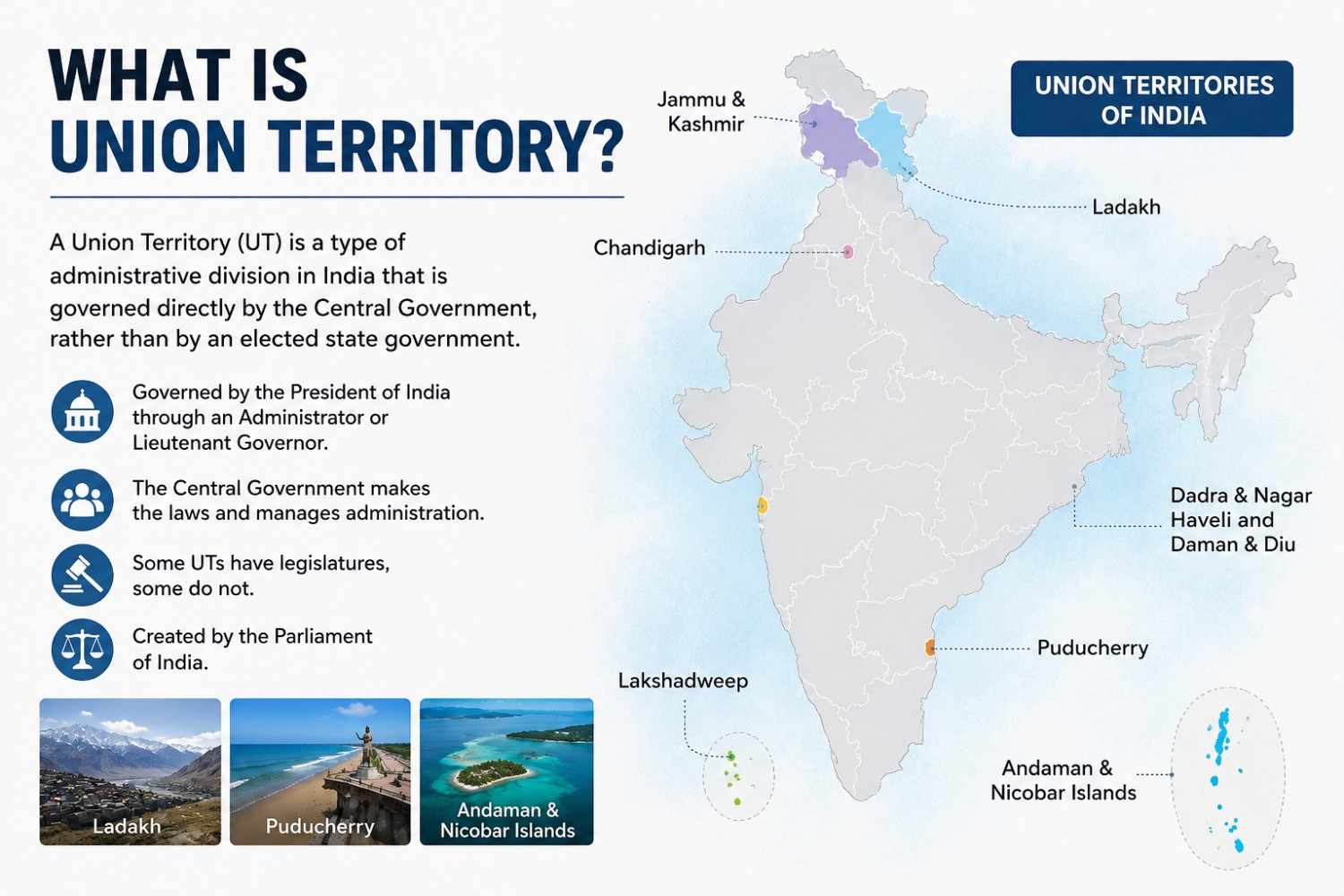
A Union Territory (UT) is a type of administrative division in India that is directly administered by the Union Government (Central Government) through a Lieutenant Governor or an Administrator appointed by the President of India. Unlike Indian states, Union Territories do not have full statehood and have limited or no legislative powers of their own.
Why Are Union Territories Created?
Union Territories are created for several reasons, including:
- Strategic importance – Some regions are militarily or geographically significant.
- Small size or population – Some areas are too small to be independent states.
- Cultural distinctiveness – Certain regions have unique cultures that require special attention.
- Administrative efficiency – Direct central control ensures better governance in sensitive areas.
List of Union Territories in India (2024)
India currently has 8 Union Territories:
| # | Union Territory | Capital | Has Legislature? |
|---|---|---|---|
| 1 | Delhi (NCT) | New Delhi | Yes |
| 2 | Jammu & Kashmir | Srinagar (S), Jammu (W) | Yes |
| 3 | Puducherry | Puducherry | Yes |
| 4 | Chandigarh | Chandigarh | No |
| 5 | Dadra & Nagar Haveli and Daman & Diu | Daman | No |
| 6 | Lakshadweep | Kavaratti | No |
| 7 | Andaman & Nicobar Islands | Port Blair | No |
| 8 | Ladakh | Leh | No |
Key Difference Between a State and a Union Territory
| Feature | State | Union Territory |
|---|---|---|
| Governance | Elected State Government | Central Government |
| Head | Governor | Lieutenant Governor / Administrator |
| Legislature | Has its own | May or may not have |
| Autonomy | High | Limited |
Key Facts About Union Territories
- Union Territories are mentioned in Article 1 and Schedule 1 of the Indian Constitution.
- The President of India appoints an Administrator or Lieutenant Governor to oversee each UT.
- Delhi, J&K, and Puducherry are the only UTs with their own legislative assemblies.
- Jammu & Kashmir was downgraded from a full state to a Union Territory in 2019.
- Chandigarh is unique as it serves as the capital of two states — Punjab and Haryana — while being a UT itself.
Conclusion
Union Territories play a vital role in India’s federal structure. They ensure that strategically important, culturally distinct, or geographically unique regions receive direct attention and governance from the Central Government. With 8 Union Territories spread across diverse landscapes — from the Himalayan heights of Ladakh to the tropical islands of Lakshadweep — India’s UTs reflect the country’s rich diversity.