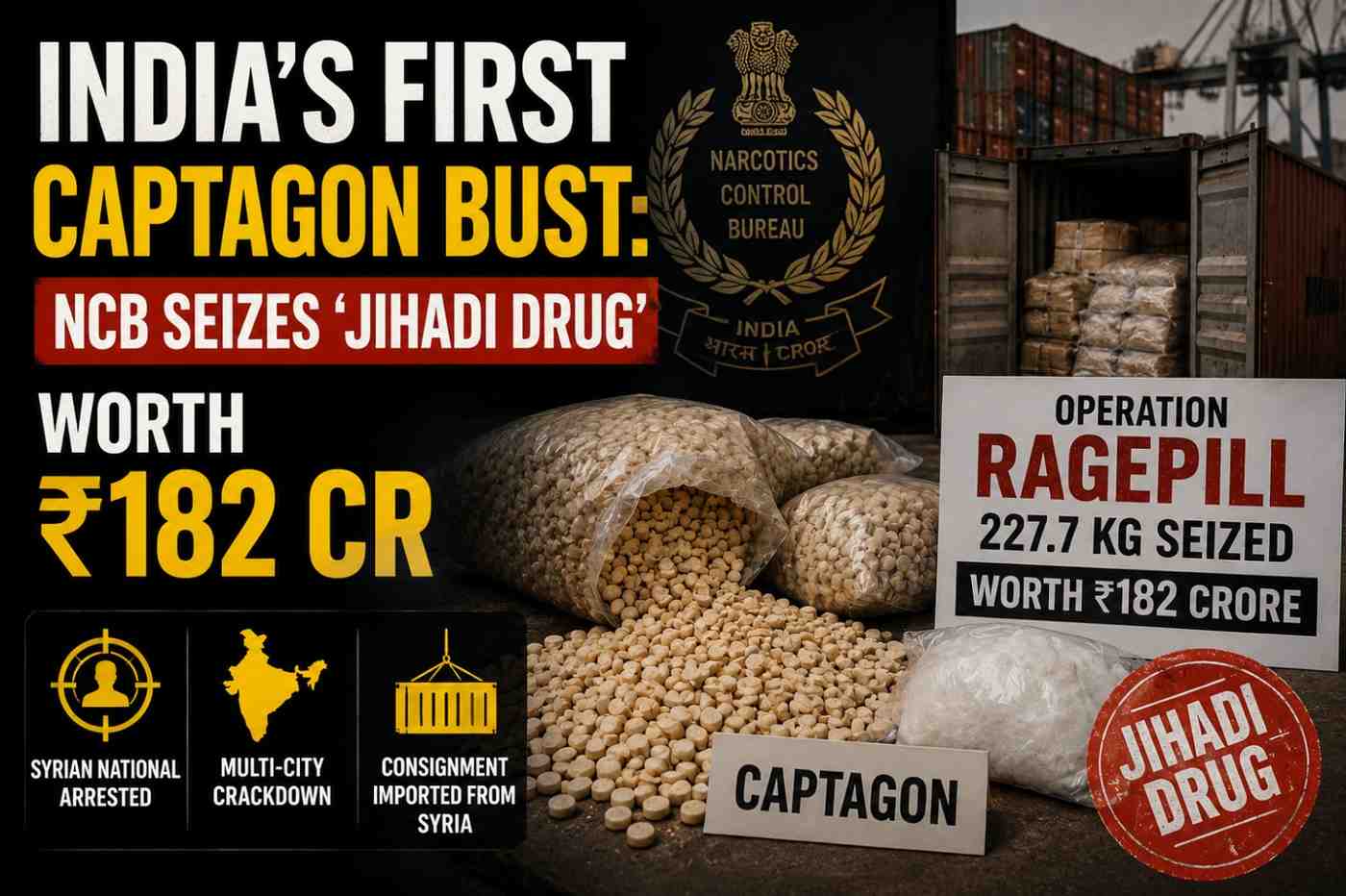
NEW DELHI — In a major breakthrough against transnational synthetic drug trafficking networks, the Narcotics Control Bureau (NCB) has unearthed an international syndicate and intercepted a massive consignment of Captagon—marking the first-ever documented seizure of the psychotropic substance on Indian soil.
The coordinated multi-city crackdown, code-named ‘Operation RAGEPILL,’ resulted in the recovery of approximately 227.7 kilograms of Captagon tablets and powder, valued at an estimated ₹182 crore in the international black market. A Syrian national who was overstaying illegally in India has been arrested in connection with the trafficking network.
Union Home Minister Amit Shah officially announced the breakthrough on Saturday, reiterating the government’s unwavering stance on cross-border drug syndicates.
“Modi govt is resolved for a ‘Drug-Free India’. Glad to share that through ‘Operation RAGEPILL’, our agencies have achieved the first-ever seizure of Captagon, the so-called ‘Jihadi Drug’, worth ₹182 crore,” Shah stated on social media platform X. “The busting of the drug consignment destined for the Middle East and the arrest of a foreign national stand out as shining examples of our commitment to zero tolerance against drugs.”
From Neb Sarai to Mundra Port: How the Bust Unfolded
According to a press release issued by the Ministry of Home Affairs, the operation commenced after the NCB received actionable intelligence from a foreign drug law enforcement agency indicating that international syndicates were attempting to use India as a transit hub for trafficking Captagon to the Gulf region.
The multi-state operation unfolded in two distinct phases:
- The Delhi Raid: On May 11, NCB operatives tracked and searched a rented house in South Delhi’s Neb Sarai area. Investigators recovered 31.5 kilograms of Captagon tablets, which had been meticulously concealed inside a commercial chapati-making machine intended for export.
- The Mundra Port Seizure: Following the interrogation of the prime suspect, a follow-up raid was executed on May 14 at the Container Facilitation Station (CFS) at Mundra Port in Gujarat. Officials intercepted a shipping container that had been imported from Syria with “sheep wool” declared as the consignment. A thorough search of the container uncovered three bags containing 196.2 kilograms of high-grade Captagon powder.
Preliminary investigations revealed that the arrested Syrian national had entered India on a tourist visa on November 15, 2024. Following the expiration of his visa on January 12, 2025, he remained in the country illegally, operating covertly from the rented accommodation in Delhi to oversee the logistics of the transit shipments.
What is ‘Jihadi Drug’ Captagon?
Captagon mainly contains fenetylline and amphetamine, which are strictly regulated psychotropic substances under India’s NDPS Act. Originally developed in the 1960s to treat medical conditions like narcolepsy and attention disorders, its highly addictive nature and potential for severe psychological abuse led to a global ban in the 1980s.
However, illicitly manufactured counterfeit versions have thrived across West Asia. It earned the moniker “Jihadi Drug” (or “poor man’s cocaine”) because of its widespread use by militant groups in conflict zones, notably during the Syrian Civil War, to boost combat endurance, eliminate fatigue, and suppress fear among fighters.
Security experts note that the illicit narco-economy surrounding the production and smuggling of Captagon pills generates billions of dollars annually, which global intelligence networks have long identified as a primary funding stream for extremist organizations and organized crime syndicates in the Middle East.
India Exploited as a Transit Shield
The seized consignment was ultimately destined for transshipment to consumer markets in the Gulf region, particularly Saudi Arabia and neighboring Middle Eastern countries. Facing intense security clampdowns on direct maritime and land routes out of the Levant, syndicates are increasingly trying to redirect cargo through South Asian commercial ports. By routing shipments through India and masking them inside legitimate commercial goods (like industrial kitchen machinery), traffickers hope to deceive customs officials at the final destination.
The NCB noted that this operation highlights a growing trend of transnational drug syndicates misusing commercial cargo and containerized trade routes, coming on the heels of another major NCB interdiction in Mumbai where 349 kilograms of cocaine were seized from an Ecuadorian container.
Home Minister Amit Shah issued a stern warning to international cartels looking to exploit Indian territory: “I repeat, we will clamp down on every gram of drugs entering India or leaving the country using our territory as the transit route. Kudos to the brave and vigilant warriors of the NCB.”