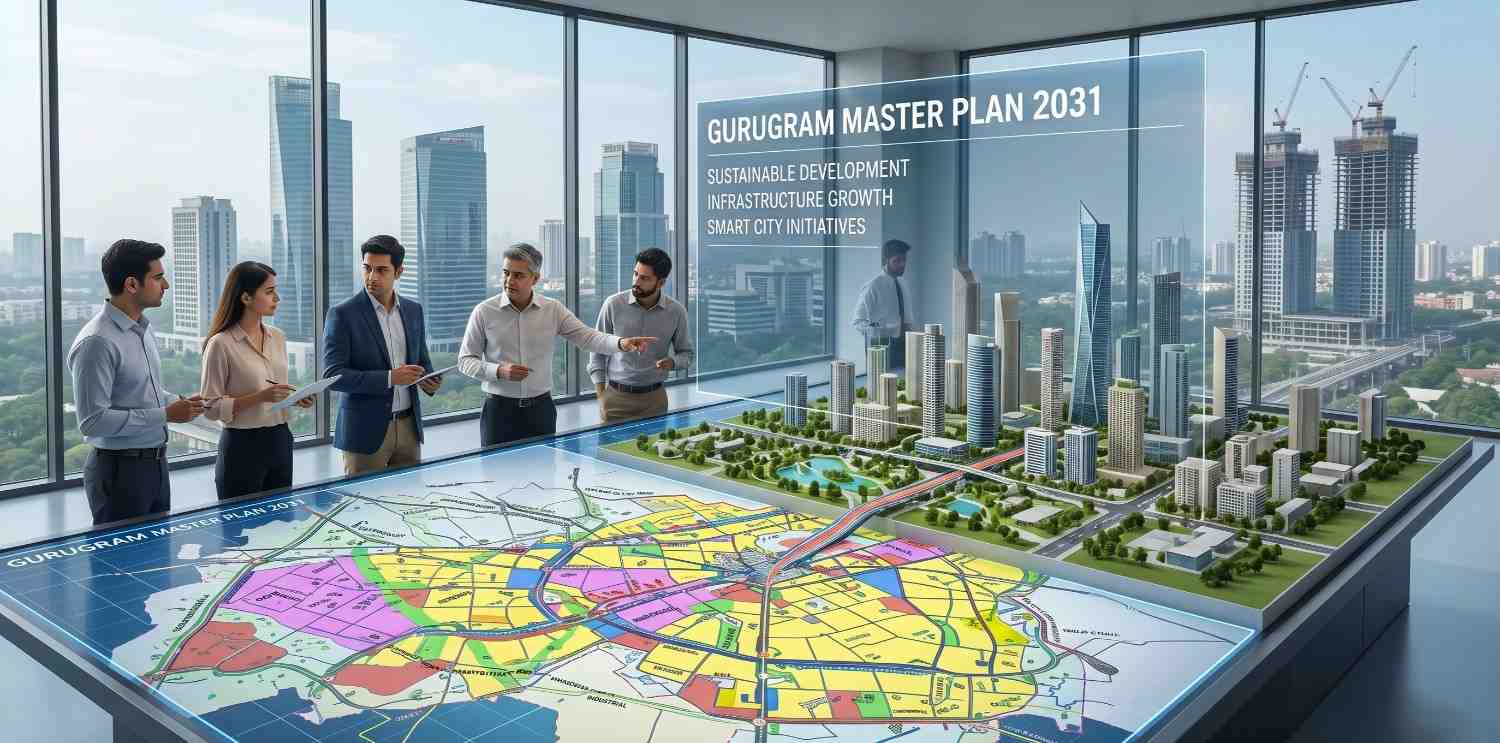
Gurugram Master Plan 2031, officially the Gurgaon-Manesar Urban Complex Development Plan 2031, is Haryana’s official blueprint published on November 15, 2012, by the Town and Country Planning Department. It covers 33,872 hectares (or 33,726 ha per some docs) of urbanizable land to support 4.25 million (42.5 lakh) people by 2031, with existing areas housing 22 lakh and new zones adding for 20.5 lakh more.
Full Background and Goals
Revising 2021/2025 plans that over-relied on SEZs (now reduced), it promotes neighborhood development at 250 persons/ha net density with integrated schools, parks, and shops to decongest Old Gurugram. Aims: Sustainable growth, industrial-residential integration (e.g., Manesar IMT), transit-oriented development (TOD) with higher FSI near stations, flood control via green spaces/water bodies, and jobs for 5 lakh+ via commercial/industrial hubs.
Comprehensive Land Use Allocation
Total breakdown from official plan:
Full Background and Goals
Revising 2021/2025 plans that over-relied on SEZs (now reduced), it promotes neighborhood development at 250 persons/ha net density with integrated schools, parks, and shops to decongest Old Gurugram. Aims: Sustainable growth, industrial-residential integration (e.g., Manesar IMT), transit-oriented development (TOD) with higher FSI near stations, flood control via green spaces/water bodies, and jobs for 5 lakh+ via commercial/industrial hubs.
Comprehensive Land Use Allocation
Total breakdown from official plan:
Color-coded map (high-res: 3840×2713 px) shows zones: Residential (light), commercial (200), industrial (300), transport (500, bold roads), greens.
Six Detailed Zones
- Zone 1: Old Gurgaon (Core): Sectors 1-56; mature infra (S14/15/13); infill only, no major expansion.
- Zone 2: New Gurgaon: Sectors 57-115; high residential/commercial growth, expanded recently.
- Zone 3: Southern Peripheral: Dwarka Expressway; luxury realty hotspot.
- Zone 4: Manesar: Industrial focus with housing integration.
- Zone 5: Sohna: Mixed emerging corridor.
- Zone 6: Extension: Buffer for future needs.
Infrastructure and Projects
- Metro: 28.5 km Gurugram Loop (HUDA City Centre-Cyber City, 27 stations, ~2027); 188 km total incl. Faridabad/Dwarka/Manesar (construction Dec 2024).
- Roads: NH-8 6-lane (Naurangpur-Rampura, ₹41.8cr); ₹800cr elevated roads/flyovers (NH-Jaipur to Vatika Chowk, 4 more); wide ROWs to Delhi.
- Global City: Sectors 36/37B (587 acres); Phase 1 ₹940cr by end-2026; 300% FAR, mixed-use, international standards; public notices for revisions (Mar 2026).
- Other: Rainwater harvesting, waste mgmt; SEZ de-notifications for residential/commercial (e.g., new sectors from SEZs, Sector 37D expansion).
2026 Updates and Personal Impact
SEZ conversions boost housing supply; property surges 20-30% yearly in Zones 2-3; shorter commutes, cleaner air from greens/metro, but construction noise short-term. Buyers: Prioritize licensed/TOD sectors; investors: Expressway zones; residents/businesses: 5 lakh jobs incoming. Guides Gurugram as millennium city.